Many people put Angkor Wat on their list of the worlds wonders and it is Cambodia’s biggest tourist drawcard attracting travellers from all over the world like moths to a flame, I visited the famous temple complex with a little trepidation, scared that this icon of the Khmer empire would be overrun by hordes of camera toting jetsetters. Angkor Wat itself is said to be the worlds largest single religious monument but the Angkor temple complex spreads over approximately 400 square km and includes many spectacular temples built by the Khmer empire between 800 – 1400 AD. The city of Angkor was also the worlds largest pre industrial city, at well over 1000 square km it had a complex water management system that supported a population of over 1 million people.
Angkor Wat is the temple that most people come to see, and for good reason, unlike the surrounding temples it was never surrendered to the elements and its architecture is simply spectacular. I arrived at sunrise hoping to get the iconic shot with the reflection of the temple in one of the surrounding ponds and of course I arrived to find hundreds of people waiting for the same thing. I’ve come to expect large crowds at popular tourist destinations but the beauty of the Angkor temples is that the area is so spread out and there is so much to see, apart from a few popular photo spots you don’t feel overwhelmed by large crowds. I spent a few hours exploring what is known as “the mother of all temples” and Angkor Wat certainly lived up to its impressive reputation, I was keen to see some of the surrounding temples however, hopefully with a few less tourists about.
Possibly the best thing about visiting the Angkor temple complex is that it is completely self-paced, it can be done in either a big or small loop by hired car, tuk tuk, bicycle or in my case motorbike, this gives exploring the temples a relaxed feel and allows everyone to have their own individual experience. The next temple I visited was also my favourite, Bayon temple, known best for its hundreds of huge smiling faces, said to be the image of king Jayavarman VII. When I arrived at Bayon there seemed to be only a few other visitors and I kind of felt like an intrepid explorer as I walked the stone passageways of the ancient temple. Within walking distance from Bayon were several other impressive temples and many smaller structures so I spent quite a few hours strolling from one to the next in absolute awe of each of them.
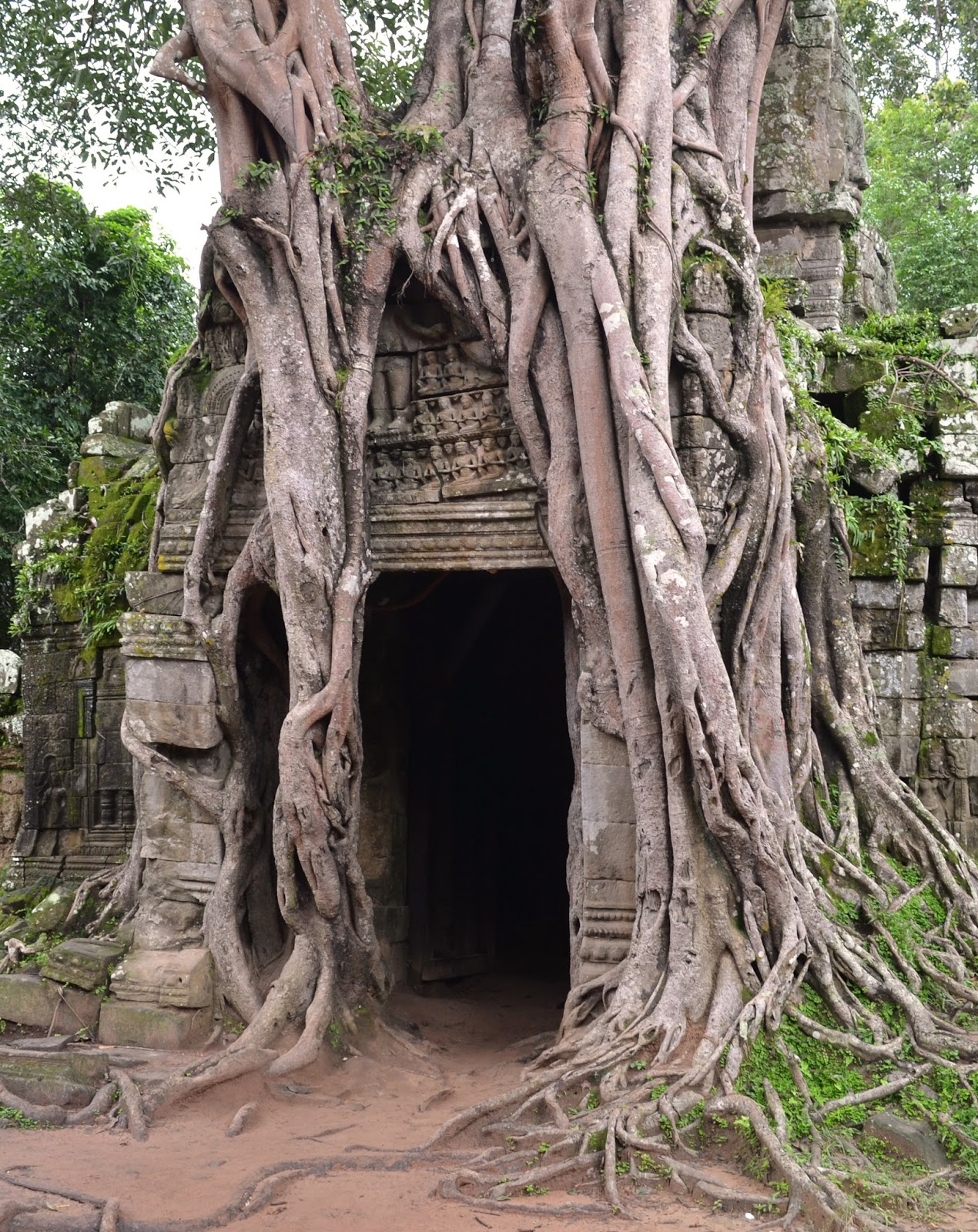
It was early afternoon and it had been a long day of sightseeing so I decided that I would make Ta Prohm my last temple for the day. Unlike many of the other temples of Angkor, Ta Prohm was largely left to the jungle, vines weave their way through moss covered stone creating a striking blend of nature and manmade architecture. Ta Prohm is also known as the tomb raider temple because scenes from the movie were filmed here and it’s not hard to channel a little bit of Lara Croft or Indiana Jones as you make your way through the ruins. Somebody told me it was impossible to take a bad photo here and perhaps they were right, there was certainly an opportunity for shutterbugs around every corner. Ta Prohm is possibly the second most popular temple in Angkor and as a result I found myself amongst groups of tourists again, all lining up at the 3 or 4 most popular spots for photos, barriers had been erected to protect the temple from the crowds, which is understandable but I was also a little frustrated that they got in the way of such great shots.
I arrived back at the temple complex early the next day and set about exploring the large loop which consisted of many smaller but still very beautiful temples on the road from Bayon to Ta Prohm. This was a really good day of exploring, most of the crowds were at the main temples so I spent the day with a handful of other tourists in tuk tuks who were moving along at the same pace as me. Each of these smaller temples had their own charm and at times I would be the only one visiting the temple so I could quietly reflect on the history that surrounded me.
I had heard about a temple 50 km from Siem Reap called Beng Mealea, it was described as the real Indiana Jones experience, it had been overgrown by jungle, however unlike Ta Prohm the jungle hadn’t been cut back so it was far more adventurous. I couldn’t resist visiting a place like that so I headed out of town to see if it was as good as what I was told. The chances of finding a unique travel experience are getting harder and harder and Beng Mealea certainly wasn’t it, my hopes of exploring a hidden jungle temple alone were dashed by the bus load of Chinese tourists that turned up at the same time as me. Having said that Beng Mealea was a lot more off the tourist path than the other temples that I had visited and far from the crowds of Angkor Wat. The beauty of this place can’t be disputed, personally I thought it was more stunning than Ta Prohm, large parts of the temple had turned to rubble so a raised walkway had been erected which offered a different perspective from the other temples I had seen. Beng Mealea is definitely worth a visit for anyone who has the time, it is also on the way to the Cambodian border for those travelling north with their own vehicle.
The Angkor temples certainly lived up to their large reputation, I left Siem Reap with a sense of wonder at the beauty, size and sheer engineering genius that went into these masterpieces of the Khmer empire
The Angkor temples certainly lived up to their large reputation, I left Siem Reap with a sense of wonder at the beauty, size and sheer engineering genius that went into these masterpieces of the Khmer empire
 |
| Add caption |


 |
| Add caption |


 |
| Add caption |
 |
| Add caption |


.
 |
| Add caption |